UN Climate Panel Warns Window to Avert Worst Outcomes Is 'Rapidly Closing'
A new report from the UN's Intergovernmental Panel on Climate Change says risks to people and ecosystems will rise unavoidably over the next 18 years, but that action taken promptly can still head off some of the gravest harms.
By Ken Adams ·
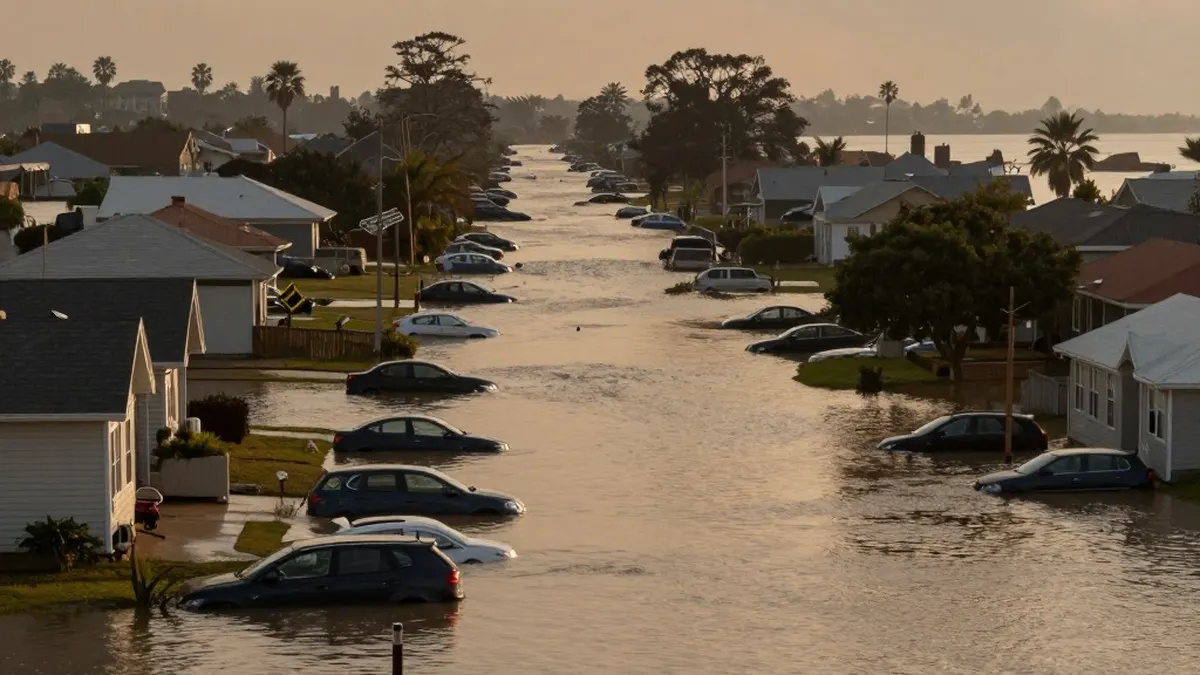
A new report from the United Nations' Intergovernmental Panel on Climate Change warns that global warming is set to make the world sicker, hungrier, poorer and more dangerous over the next 18 years, with an "unavoidable" increase in risks. The report, released Monday, describes a planet already battered by deadly heat, fires, floods and drought.
If human-caused warming is not held to just a few more tenths of a degree, the panel says, conditions will deteriorate in 127 ways in coming decades, and some of the damage could be "potentially irreversible." The authors write that delaying emissions cuts and adaptation efforts "will miss a brief and rapidly closing window of opportunity to secure a liveable and sustainable future for all."
The report says at least 3.3 billion people already live in circumstances that are "highly vulnerable to climate change" and are 15 times more likely to die from extreme weather. Large numbers of people are being displaced, and the world's poor are bearing the heaviest burden. Children alive today who live to see 2100 would face four times as many climate extremes as now even with only a few more tenths of a degree of warming, and five times as many if temperatures rise nearly 2 degrees Celsius (3.4 degrees Fahrenheit) from today's level.
Deaths from heat waves, disease, extreme weather, air pollution and starvation are expected to climb, though the toll depends on how much heat-trapping gas is emitted and how well societies adapt. "Climate change is killing people," said co-author Helen Adams of King's College London. "Yes, things are bad, but actually the future depends on us, not the climate." By 2050, a billion people will face coastal flooding risk from rising seas, according to the report. It also points to a new emphasis on mental health, including anxiety among young people worried about their futures.
UN Secretary-General Antonio Guterres called the document "an atlas of human suffering and a damning indictment of failed climate leadership." The report's co-chairs stressed the speed of change. Debra Roberts of South Africa spoke of "real existential threats," while Hans-Otto Poertner of Germany said: "Every bit of warming matters. The longer you wait… the more you will pay later." Co-author Maarten van Aalst said risks are arriving faster than expected when the previous version appeared in 2014.
Much of Africa, parts of Central and South America and South Asia are identified as hot spots for the worst harms. Some places, including certain small islands, could become uninhabitable, and in some regions it may become too hot to work outdoors, threatening crop production. Warming of another nine-tenths of a degree Celsius (1.6 degrees Fahrenheit) would increase the area burned by wildfires worldwide by 35%. Two species, Australia's Bramble Cays melomys and Central America's golden toad, have already gone extinct because of climate change.
The report also sharpens its focus on the 1.5 degree Celsius (2.7 degrees Fahrenheit) threshold set in the 2015 Paris agreement. With the world already 1.1 degrees Celsius warmer than pre-industrial times and emissions still rising, most scenarios show that mark being reached in the 2030s. Some officials have counted on overshooting it and later bringing temperatures back down with unproven, costly carbon-removal technology. The report cautions that an overshoot would bring severe additional risks, some irreversible even if warming later declines, though scientists note the world does not fall off a cliff at that mark.
The authors call for more adaptation, with wealthier nations providing better financial help to poorer countries, while noting that adaptation has limits and that fixes such as sea walls can worsen conditions elsewhere. The 36-page summary, condensed from more than 1,000 pages of analysis, was approved by consensus on Saturday during a two-week virtual meeting held as Russia invaded Ukraine; some authors said a Ukrainian delegate pleaded that the war not overshadow the findings.
Experts urged realism rather than despair. German Vice Chancellor Robert Habeck said, "Fear is not a good advisor and never is. Hope is the right one." Climate scientist Katharine Hayhoe, who did not take part in the report, said: "It's really bad and there's a good chance that it will get worse. But if we do everything we can, that will make a difference."
Source: Chicago Tribune